
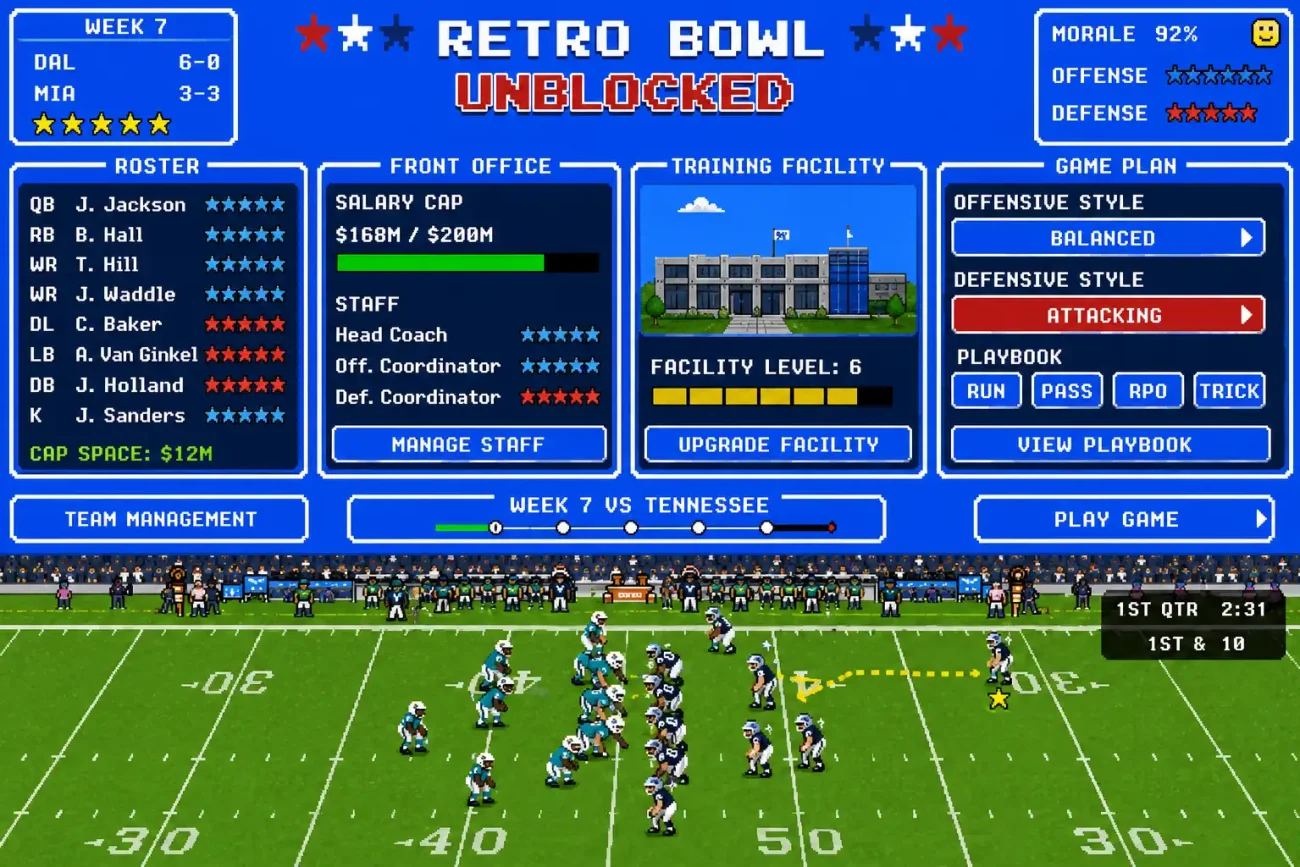
Retro Bowl combines classic arcade football with franchise management, giving players much more than a typical sports game. Instead of controlling an entire team on every play, you become the coach, general manager, and offensive leader responsible for building a championship-winning franchise over multiple seasons.
If you’re searching for Retro Bowl Unblocked, you probably want to enjoy the game from a browser while learning how to win consistently, draft better players, manage your salary cap, and develop a successful team.
This guide is designed specifically for beginners and intermediate players. If you’re looking for more browser-based sports titles, you can also explore our Basketball Stars Unblocked guide. Rather than offering generic gaming advice, you’ll learn how Retro Bowl’s unique mechanics work, how to build a balanced roster, when to spend Coaching Credits, and the strategies that experienced players use to win championships season after season.
By the end of this guide, you’ll understand not only how to play Retro Bowl but also how to build a long-term football dynasty.
Retro Bowl Quick Facts
| Feature | Details |
|---|---|
| Game Genre | Arcade Football & Franchise Management |
| Main Objective | Build a championship-winning football team |
| Gameplay Style | Offensive gameplay with franchise management |
| Difficulty | Easy to learn, challenging to master |
| Main Skills | Passing, roster building, drafting, salary management |
| Team Management | Yes |
| Player Development | Yes |
| Draft System | Yes |
| Seasons | Unlimited |
| Best For | Sports game fans who enjoy long-term progression |
What Is Retro Bowl?
Fans who enjoy football strategy games often enjoy other competitive browser games available in our Unblocked Games collection. Retro Bowl is a football game that combines fast arcade action with franchise management. Instead of focusing only on individual matches, the game places equal importance on building your team across multiple seasons.
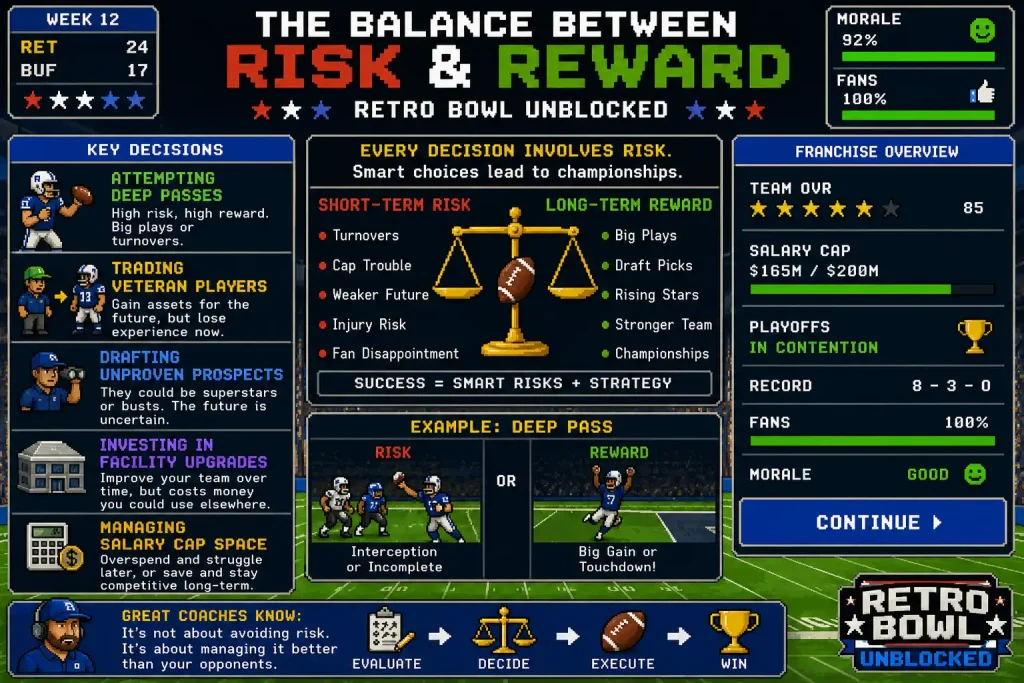
Every decision affects your future success.
You are responsible for:
- Drafting rookie players
- Trading veterans
- Managing player morale
- Upgrading facilities
- Hiring coordinators
- Spending Coaching Credits wisely
- Winning regular-season games
- Reaching the playoffs
- Building a championship team
Unlike many football games where every match feels independent, every season in Retro Bowl builds upon the previous one.
A poor draft may weaken your franchise for several seasons.
A smart investment can turn an average team into a championship contender.
This long-term progression is one of the biggest reasons why players continue returning to Retro Bowl.
Why Retro Bowl Is Different From Most Football Games
Many football games focus almost entirely on gameplay.
Retro Bowl goes much further.
Winning games is only one part of becoming successful.
You must also think like a general manager.
For example, imagine your star quarterback is getting older.
Should you:
- Extend his contract?
- Trade him?
- Draft a replacement?
- Save salary cap space?
There is rarely one perfect answer.
Every decision affects future seasons.
This strategic layer makes Retro Bowl feel completely different from arcade football games where every match resets your progress.
Every Season Has Consequences
If your roster becomes old, performance declines.
If player morale drops, mistakes become more common.
If facilities remain poor, injuries become more frequent.
If Coaching Credits are wasted, rebuilding becomes much harder.
Instead of thinking about today’s game, experienced Retro Bowl players constantly plan several seasons ahead.
That long-term thinking separates average teams from championship dynasties.
How Retro Bowl Gameplay Works
Retro Bowl combines football strategy with simple controls.
The gameplay itself is easy to understand.
However, making the correct decisions throughout an entire season requires planning and patience.
Each season follows a similar structure.
- Build your roster.
- Play regular-season games.
- Improve your players.
- Earn Coaching Credits.
- Upgrade facilities.
- Reach the playoffs.
- Compete for the championship.
- Prepare for the next draft.
This cycle repeats every season.
The interesting part is that your franchise gradually improves over time.
Unlike games where you start from zero after every match, Retro Bowl rewards long-term development.
Offensive Gameplay
During games, you primarily control the offense.
Your responsibilities include:
- Calling passing plays
- Choosing running opportunities
- Managing the game clock
- Scoring touchdowns
- Protecting the football
Every possession matters.
Throwing unnecessary interceptions often changes the outcome of close games.
Experienced players understand that protecting possession is usually more valuable than forcing risky deep passes.
Defense Is Managed Differently
One feature that surprises many beginners is defensive gameplay.
Rather than manually controlling defenders on every snap, defensive performance depends heavily on your roster quality.
This means defensive success starts long before kickoff.
Strong defensive players improve your chances of forcing punts, turnovers, and field goals.
Weak defensive rosters often struggle regardless of how well your offense performs.
Because of this, many new players underestimate defensive drafting.
Building a complete roster eventually becomes more important than simply improving offensive stars.
Every Match Supports Your Long-Term Progress
Winning games earns rewards.
These rewards help strengthen your franchise.
For example, successful seasons can lead to:
- Better draft opportunities
- More Coaching Credits
- Improved facilities
- Higher player development
- Greater franchise stability
This creates a satisfying progression loop.
Winning one game is helpful.
Building a team capable of winning every season is much more rewarding.
Retro Bowl Controls Explained
The controls are intentionally simple.
This allows players to spend more time thinking about strategy instead of memorizing complicated button combinations.
| Action | Purpose |
|---|---|
| Aim Pass | Drag to target your receiver |
| Throw Football | Release your pass |
| Move Ball Carrier | Swipe or directional movement depending on platform |
| Dive | Gain extra yards safely |
| Juke | Avoid defenders |
| Pause | Manage settings and game options |
Although the controls are simple, timing makes a huge difference.
A perfectly timed short pass often produces better results than a risky deep throw.
Learning when to release the football is one of the first skills every new player should master.
First Things Every New Player Should Do
Many beginners immediately start upgrading random players or spending Coaching Credits without a plan.
This usually slows long-term progress.
Instead, begin with these priorities.
Learn Passing Before Running
Passing is the foundation of Retro Bowl’s offense.
Although running plays can be useful, successful teams usually rely on accurate passing.
Practice:
- Short passes
- Medium throws
- Leading receivers
- Reading open space
Once these become comfortable, your offense becomes much more consistent.
Don’t Spend Every Coaching Credit
One of the biggest beginner mistakes is spending every Coaching Credit as soon as it becomes available.
This often leaves your franchise unable to respond to future problems.
For example, an unexpected injury or poor draft class may require immediate investment.
Saving some Coaching Credits gives your team much greater flexibility later in the season.
Experienced players rarely spend everything immediately.
Instead, they keep resources available for important upgrades.
Understand Team Ratings
Your roster contains players with different overall ratings.
Higher ratings generally mean stronger performance.
However, ratings alone don’t tell the complete story.
Player age, morale, condition, and development all influence performance.
For example:
An experienced four-star player with poor morale may perform worse than a motivated three-star player.
This is why successful franchise management requires paying attention to much more than overall ratings.
Understanding Coaching Credits
Coaching Credits are one of the most valuable resources in Retro Bowl.
Every decision involving them affects your franchise.
Think of Coaching Credits as your team’s investment budget.
You can spend them on:
- Player improvements
- Staff upgrades
- Facilities
- Team development
- Long-term franchise growth
The challenge isn’t earning Coaching Credits.
The challenge is deciding where they create the greatest value. If you enjoy games that combine strategy with quick decision-making, you may also like Subway Surfers Unblocked Games, which rewards timing and fast reactions.
Should You Spend Or Save Coaching Credits?
This is one of the biggest strategic questions in Retro Bowl.
There isn’t one correct answer.
Instead, your decision depends on the condition of your franchise.
| Spend Immediately | Save for Later |
|---|---|
| Weak quarterback | Upcoming draft |
| Serious injuries | Salary flexibility |
| Poor facilities | Future upgrades |
| Low morale | Better free agents |
| Emergency rebuilding | Long-term planning |
Learning when not to spend Coaching Credits is just as important as knowing when to use them.
Many championship franchises succeed because they avoid unnecessary spending early in the season.
The Biggest Coaching Credit Mistake
Some players spend every available credit upgrading one star player.
While this feels rewarding in the short term, it often creates an unbalanced roster.
A single superstar cannot carry an entire franchise forever.
Instead, spread your investments across:
- Quarterback development
- Receiver improvements
- Defensive upgrades
- Facility improvements
- Staff development
Balanced teams consistently outperform teams that rely on one or two elite players.
How Passing Really Works
Passing is the skill that separates beginners from experienced Retro Bowl players.
Many new players assume every open receiver should receive the football.
This leads to unnecessary interceptions.
Instead, successful quarterbacks evaluate three questions before every throw.
Is My Receiver Actually Open?
A receiver may appear open initially.
However, defenders can close space very quickly.
Learning to anticipate defensive movement is much more important than reacting after a receiver becomes covered.
Can My Receiver Gain Extra Yards?
Sometimes the safest pass isn’t the best pass.
If another receiver has more open field after the catch, that option may produce a much larger gain.
Experienced players constantly think beyond the catch itself.
They ask:
“What happens after my receiver catches the football?”
This simple mindset dramatically improves offensive efficiency.
Is This Throw Worth The Risk?
Every pass carries some risk.
Throwing into double coverage rarely ends well.
Sometimes accepting a shorter gain keeps your offense moving while avoiding turnovers.
Winning football isn’t always about spectacular plays.
Often, it’s about making smart decisions consistently.
Building a Championship Team in Retro Bowl
Learning how to pass the football is only the beginning. The teams that consistently win Retro Bowl championships are built through smart roster decisions, balanced player development, and long-term planning. A great quarterback can win games, but a complete roster wins seasons.
Many beginners make the mistake of signing or upgrading players simply because they have high ratings. Experienced players look beyond overall ratings and think about age, salary, morale, and future development.
In this section, you’ll learn how to build a franchise that stays competitive for many seasons instead of relying on one or two star players.
How the Retro Bowl Draft Works
The draft is one of the most important events in every season.
This is your opportunity to add young talent, replace aging veterans, and strengthen weak areas of your roster.
Unlike free agency, drafted players usually offer better long-term value because they have more room to develop.
Every draft should begin with one question:
Which position will improve my team the most over the next three seasons?
Thinking long-term often produces better results than selecting the highest-rated player available.
Prioritize Team Needs Instead of Overall Ratings
Imagine your team already has an excellent quarterback.
The draft presents another highly rated quarterback along with a very good wide receiver.
Many beginners automatically choose the highest-rated player.
A smarter decision may be selecting the receiver because your quarterback position is already secure.
Always evaluate your roster before making draft selections.
Ask yourself:
- Which position struggles the most?
- Which player is nearing retirement?
- Which contract expires soon?
- Where do I need more depth?
A balanced team usually performs better than one filled with duplicate strengths.
Best Positions to Draft First
Not every position has the same impact on your success.
When rebuilding a franchise, these positions usually provide the greatest value.
Quarterback
The quarterback controls your offense.
Accurate passing, good arm strength, and consistency make this the most valuable offensive position.
If your current quarterback is aging or struggling, drafting a talented replacement should become a priority.
A franchise quarterback can remain productive for many seasons.
Wide Receiver
Even the best quarterback needs reliable receivers.
Wide receivers create separation, catch difficult passes, and generate yards after the catch.
Many successful offenses feature at least one elite receiver capable of making difficult catches under pressure.
Running Back
Running backs provide balance.
Although passing wins many games, running the football prevents defenses from focusing entirely on your passing attack.
A reliable running back also helps during short-yardage situations.
Tight End
Tight ends often become valuable safety options.
When deep receivers are covered, a dependable tight end can consistently move the chains.
Many beginners underestimate this position.
Defensive Players
Defense may not be manually controlled, but strong defenders still influence game outcomes.
Quality defensive players improve your chances of:
- Forcing punts
- Creating turnovers
- Reducing opponent scoring
- Winning close games
Ignoring defense usually results in high-scoring games where your offense must constantly play catch-up.
Rookie Draft Strategy
Your first few drafts determine how quickly your franchise improves.
Instead of selecting players randomly, follow a simple rebuilding strategy.
Year One
Focus on the offense.
Improve your quarterback and receiving options.
Scoring points consistently makes rebuilding much easier.
Year Two
Strengthen the defense.
A stronger defense creates shorter fields for your offense and reduces pressure on every drive.
Year Three
Fill remaining weaknesses.
Upgrade aging veterans and improve overall roster depth.
By this point your franchise should become a consistent playoff contender.
Common Draft Mistakes
Many players waste valuable draft opportunities.
Avoid these mistakes.
Drafting Only High-Rated Players
Overall ratings matter.
Team balance matters more.
A five-star player cannot solve every weakness.
Ignoring Player Age
Older players may perform well immediately.
However, younger players often provide better long-term value.
Building around younger talent creates a stronger franchise over multiple seasons.
Forgetting About Salary
Every new player eventually affects your salary cap.
Signing too many expensive stars creates financial problems later.
Always think several seasons ahead.
Drafting Too Many Skill Positions
Quarterbacks and receivers are exciting.
However, successful teams require balance.
Ignoring defense or offensive depth eventually becomes costly.
Understanding the Salary Cap
The salary cap limits how much money your team can spend on player contracts.
Managing it effectively is one of the biggest challenges in Retro Bowl.
Many beginners discover this problem only after assembling several star players.
Eventually, they cannot afford to keep everyone.
Planning ahead prevents difficult decisions later.
Why Salary Cap Management Matters
Imagine your quarterback, top receiver, and best defender all need new contracts during the same offseason.
Without enough salary cap space, you may lose one or more key players.
Good salary management helps you:
- Keep important stars
- Avoid emergency trades
- Maintain roster balance
- Build long-term stability
Championship teams rarely become successful by spending heavily every season.
Instead, they invest carefully.
Signs Your Salary Cap Needs Attention
Watch for these warning signs.
- Too many expensive veterans
- Several contracts expiring together
- Difficulty signing rookies
- Limited flexibility during free agency
Addressing these issues early makes rebuilding much easier.
Should You Trade Players?
Trading players can feel difficult, especially when they have contributed to many victories.
However, successful franchises understand that every player eventually reaches a point where trading creates greater long-term value.
Consider trading when:
- A player is declining rapidly.
- Salary demands become excessive.
- A younger replacement is ready.
- Draft picks offer greater future value.
Trading at the right time often strengthens your franchise more than keeping an aging veteran.
Building a Balanced Offense
Many new players build an offense around one superstar.
While exciting, this strategy has limitations.
Defenses become easier to predict when only one player receives most of the opportunities.
Balanced offenses spread the football across multiple weapons.
Benefits include:
- Better passing options
- Reduced defensive pressure
- More consistent drives
- Greater scoring efficiency
When every receiver becomes a realistic threat, defenses struggle to predict your next play. Looking for another competitive multiplayer experience? Check out our Basketball Stars Unblocked guide for shooting, defense, and one-on-one strategies.
Player Morale Explained
Morale influences how players perform throughout the season.
Even talented athletes can struggle if morale remains low.
Players with strong morale often perform more consistently during important moments.
Poor morale may contribute to:
- Missed opportunities
- Lower consistency
- Reduced development
- Team instability
Maintaining positive morale becomes increasingly important as your roster improves.
How to Improve Player Morale
Several actions can help keep players motivated.
Win Games
Success naturally improves team confidence.
Winning streaks often create positive momentum.
Manage Players Fairly
Avoid making unnecessary changes that disrupt team chemistry.
Consistent leadership helps players remain confident.
Upgrade Team Facilities
Improved facilities contribute to player satisfaction while also supporting long-term development.
Facilities are investments rather than short-term expenses.
Understanding Player Condition
Condition represents how physically prepared players are for upcoming games.
Poor condition increases fatigue and may reduce performance.
Over an entire season, maintaining good condition becomes extremely important.
Why Condition Matters
Imagine playing several difficult games in consecutive weeks.
Without proper recovery, players become less effective.
Healthy, well-rested players generally perform more consistently than exhausted stars.
This is another reason facilities deserve careful investment.
Facilities Every Franchise Should Upgrade
Facilities influence far more than appearance.
They directly affect player development and long-term success.
Training Facilities
Training facilities help players improve their abilities over time.
Investing here benefits young players the most because they have greater room for development.
Rehabilitation Facilities
Rehabilitation focuses on player recovery.
Healthy players remain available for more games throughout the season.
This becomes increasingly valuable during playoff runs.
Stadium Improvements
Although stadium upgrades may seem less exciting than player upgrades, stronger fan support generates additional resources that benefit the franchise over time.
Think of stadium improvements as long-term investments.
Should You Upgrade Players or Facilities First?
This question has no universal answer.
However, many experienced players follow this approach.
| Franchise Situation | Better Investment |
|---|---|
| Weak roster | Improve key players |
| Young rebuilding team | Training facilities |
| Frequent injuries | Rehabilitation facilities |
| Stable playoff team | Balanced upgrades |
| Championship contender | Fill remaining weaknesses |
The goal is balance.
Ignoring facilities slows long-term development.
Ignoring players makes winning difficult today.
Building Depth Instead of Superstars
One superstar cannot carry an entire franchise forever.
Eventually:
- Players become injured.
- Contracts expire.
- Performance declines.
- Opponents improve.
Depth protects your team from unexpected setbacks.
Instead of relying on one five-star player, aim to build several dependable contributors.
Championship teams usually have strength across the entire roster rather than concentrating resources in one position.
Advanced Passing Strategies
By now, you should understand the basics of building a franchise and managing your roster. The next step is improving your decision-making during games. Many Retro Bowl players lose close matches not because their team lacks talent, but because they force difficult throws, waste possessions, or mismanage the clock.
Championship teams don’t rely on spectacular plays every drive. Instead, they consistently make smart decisions that keep the offense moving while limiting mistakes.
Read the Defense Before Every Throw
One of the biggest differences between beginners and experienced players is how they read the field.
Instead of deciding where to throw before the play begins, successful players wait a moment to see how defenders react.
Before releasing the football, quickly ask yourself:
- Which receiver has the most open space?
- Is a defender moving toward the passing lane?
- Can my receiver gain additional yards after the catch?
- Is a short completion safer than forcing a deep pass?
Making these observations only takes a second, but they dramatically reduce interceptions.
Use Short Passes to Control the Game
Many players become obsessed with long touchdown passes.
While deep throws are exciting, they also carry greater risk.
Short passes provide several important advantages:
- Higher completion percentage
- Better ball control
- Longer offensive drives
- Fewer turnovers
- More predictable offensive rhythm
Consistently gaining six to ten yards often produces better results than repeatedly attempting forty-yard passes.
Lead Your Receivers
Throwing directly at a receiver isn’t always the best option.
Instead, lead receivers into open space whenever possible.
This allows them to:
- Catch the football while moving
- Avoid defenders
- Gain additional yards
- Continue offensive momentum
Learning proper pass placement is one of the fastest ways to improve your offense.
Don’t Force Throws Under Pressure
Pressure causes panic.
Many interceptions happen because players refuse to accept a short gain.
Sometimes the smartest decision is taking an easy completion instead of attempting a risky touchdown.
Football rewards patience.
Long drives often frustrate defenses far more than one spectacular play.
Clock Management
Winning isn’t always about scoring quickly.
Sometimes controlling the clock is the best strategy.
Late in close games, every possession becomes valuable.
If your team has a lead during the final minutes, avoid rushing unnecessary plays.
Instead:
- Stay in bounds.
- Complete safe passes.
- Use reliable running plays.
- Protect possession.
Forcing the opponent to use timeouts often becomes just as valuable as scoring another touchdown.
When Should You Play Faster?
There are situations where increasing the pace makes sense.
For example:
- You’re trailing late in the game.
- Very little time remains.
- The defense is allowing easy completions.
- You need one final scoring drive.
Understanding when to slow down and when to speed up separates good players from great ones.
Red Zone Strategy
The field becomes much smaller near the goal line.
Passing windows shrink.
Defenders react faster.
This means your strategy should change.
Be Patient Inside the 20
Many interceptions occur because players try forcing touchdown passes immediately.
Instead:
- Take safe completions.
- Wait for open receivers.
- Avoid crowded passing lanes.
- Keep possession alive.
Scoring after ten disciplined plays is better than turning the football over after one risky throw.
Running Can Become More Valuable
Near the goal line, defenses expect passing plays.
Mixing in occasional running plays helps keep the defense honest.
Balanced offenses become much harder to stop.
Should You Go for Two Points?
This decision depends on the situation.
Consider Going for Two When
- You need eight points.
- You’re protecting a late lead.
- Your offense has been highly effective.
- Game circumstances require additional points.
Kick the Extra Point When
- The game remains close.
- Early in the contest.
- One point provides sufficient value.
- No additional risk is necessary.
Avoid making emotional decisions.
Always think about the scoreboard first.
Defensive Roster Planning
Although you don’t manually control defenders, defense still wins games.
Strong defensive units create:
- More punts
- Better field position
- Additional offensive possessions
- Lower opponent scoring
Ignoring defense usually forces your offense to score on nearly every drive.
Which Defensive Players Matter Most?
Rather than signing every available defender, build balance.
Focus on players who consistently improve overall defensive performance instead of collecting stars at one position.
Balanced defensive rosters perform more consistently throughout long seasons.
Fifteen Beginner Mistakes That Hurt Every Franchise
Many Retro Bowl players repeat the same mistakes.
Avoiding them immediately improves your chances of success.
1. Throwing into double coverage
Wait for receivers to separate.
2. Ignoring the salary cap
Always think several seasons ahead.
3. Spending every Coaching Credit
Keep resources available for emergencies.
4. Drafting without a plan
Choose players who solve actual roster weaknesses.
5. Ignoring defense
Defense contributes far more than many beginners realize.
6. Trading young players too early
Patience often produces better long-term value.
7. Keeping expensive veterans too long
Every player eventually declines.
Trade players before their value disappears.
8. Chasing only five-star players
Balanced rosters outperform superstar collections.
9. Forgetting player morale
Happy players generally perform more consistently.
10. Ignoring facilities
Facilities influence long-term franchise development.
11. Throwing deep every drive
Explosive plays are helpful.
Consistent offense wins championships.
12. Panicking after one interception
One mistake shouldn’t change your entire strategy.
Stay patient.
13. Building only offense
Eventually you’ll need defense to win close games.
14. Forgetting long-term planning
Always ask how today’s decision affects future seasons.
15. Constantly rebuilding
Sometimes the best move is keeping a successful roster together.
Ten Proven Tips to Win More Games
These habits consistently improve performance.
- Build around an excellent quarterback.
- Upgrade facilities gradually.
- Protect the football.
- Use short passes often.
- Strengthen your defense every season.
- Keep Coaching Credits in reserve.
- Draft younger players whenever possible.
- Replace declining veterans before performance drops.
- Improve roster depth instead of collecting stars.
- Think about next season before making major decisions.
How to Build a Championship Dynasty
Winning one championship is exciting.
Winning multiple championships requires consistency.
Successful franchises usually follow the same pattern.
Step One
Find a franchise quarterback.
Step Two
Develop dependable receivers.
Step Three
Strengthen your defense.
Step Four
Improve facilities.
Step Five
Manage contracts carefully.
Step Six
Continue drafting young talent every season.
Step Seven
Replace aging players before decline becomes severe.
Step Eight
Avoid unnecessary rebuilding.
A stable franchise usually performs better than one constantly changing direction.
Frequently Asked Questions
Is Retro Bowl difficult for beginners?
No. The controls are simple, making the game easy to learn. However, mastering franchise management, drafting, and long-term planning requires experience.
What is the best position to draft first?
If your roster lacks a reliable quarterback, that position should usually become the highest priority. Otherwise, strengthen the weakest area of your team.
Should I spend Coaching Credits immediately?
Not always.
Saving Coaching Credits provides flexibility for injuries, facility improvements, and future roster upgrades.
Is passing better than running?
Passing generally creates more explosive offense.
However, mixing running plays keeps defenses balanced and improves overall efficiency.
How important is defense?
Very important.
Although you don’t manually control defenders, defensive quality influences possessions, turnovers, and opponent scoring.
Should I trade veteran players?
If performance declines or salary demands become excessive, trading veterans before their value drops can strengthen your franchise.
How do I improve player morale?
Winning games, maintaining facilities, and making smart roster decisions all contribute to better morale.
Why do my players become tired?
Condition naturally decreases throughout the season.
Investing in rehabilitation facilities helps players recover more effectively.
Is building facilities worth it?
Yes.
Facilities improve long-term player development, recovery, and overall franchise stability.
Can one superstar carry my team?
Only for a limited time.
Balanced rosters consistently outperform teams built around one elite player.
Want to discover more browser games? Visit our complete Browser Games Guide.
Final Thoughts
Retro Bowl offers much more than fast-paced football gameplay. Every season challenges you to think like both a coach and a general manager, balancing short-term success with long-term franchise growth.
The strongest teams are not always those with the highest-rated players. Instead, championship franchises are built through smart drafting, careful salary cap management, balanced roster construction, and disciplined decision-making on the field.
If you’re new to Retro Bowl Unblocked, begin by mastering the fundamentals. Learn accurate passing, protect the football, and avoid unnecessary risks. As your confidence grows, focus on building a deeper roster, improving facilities, and planning several seasons ahead rather than concentrating only on the next game.
Over time, you’ll discover that the most rewarding part of Retro Bowl isn’t simply winning a single championship—it’s creating a franchise capable of competing for titles year after year.
With patience, smart management, and consistent decision-making, you’ll be well prepared to turn an average team into a lasting football dynasty. Continue exploring more free browser games with our complete Sports Games Collection.
