
Two slot games can have the same RTP and similar-looking reels yet produce very different playing experiences. One may deliver small wins fairly regularly, while another may go through longer periods without significant payouts before producing a much larger win.
The reason is often slot volatility.
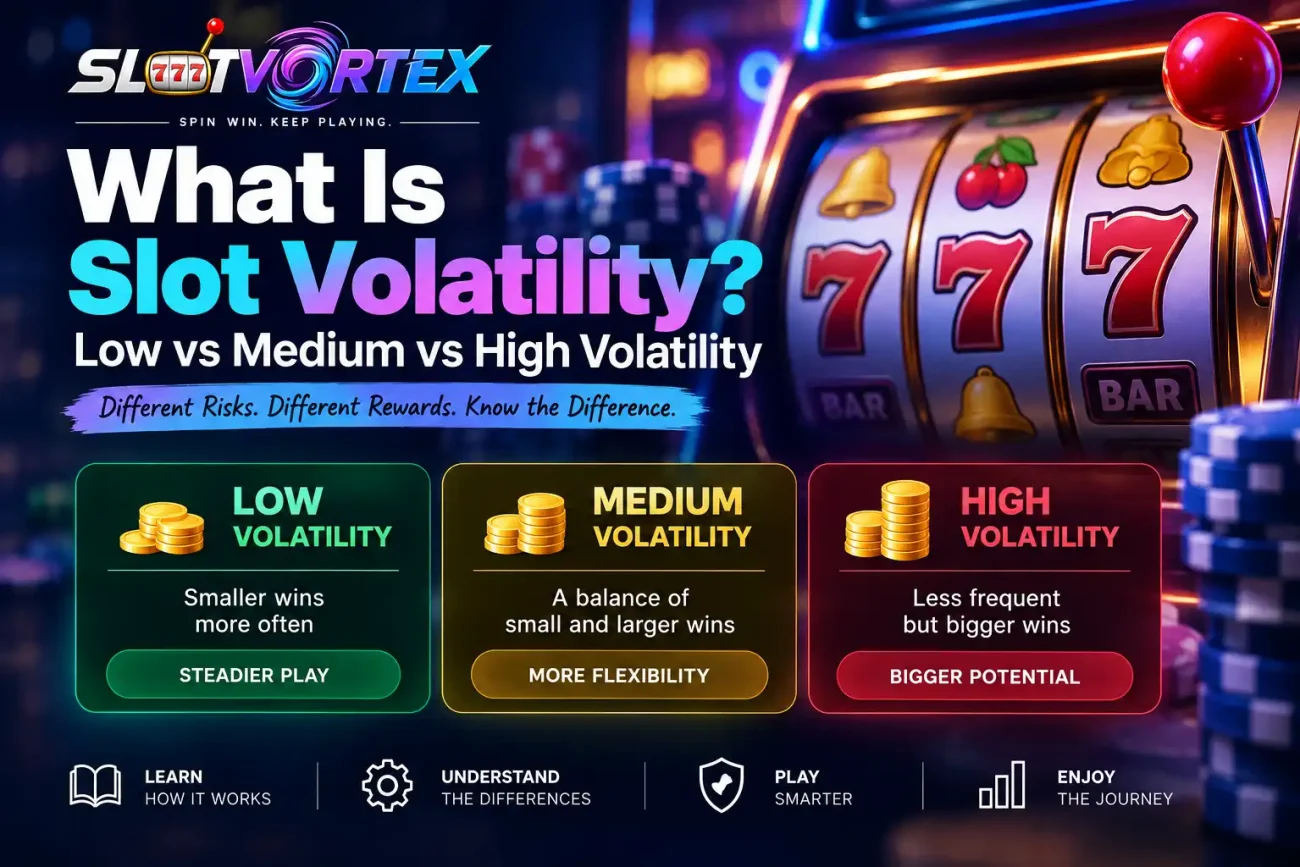
Slot volatility describes how the payouts of a slot are distributed in terms of their typical size and frequency. Low-volatility slots generally produce smaller wins more often. High-volatility slots tend to produce wins less frequently, with the possibility of larger payouts. Medium-volatility slots sit somewhere between the two.
Understanding volatility will not tell you when a slot will pay. Instead, it helps you understand the type of variation you may experience while playing.
If you are completely new to the mechanics behind these games, start with our guide explaining how online slots work.
Slot Volatility Meaning in Simple Terms
Think of volatility as a description of a slot’s payout pattern, rather than a prediction of individual spins.
Slots are commonly described as:
- Low volatility
- Medium volatility
- High volatility
You may also see terms such as low variance or high variance used in similar contexts.
Here is the basic difference:
| Volatility Level | Typical Win Frequency | Typical Win Size | Playing Experience |
|---|---|---|---|
| Low | More frequent | Usually smaller | Generally steadier |
| Medium | Moderate | Mix of smaller and larger wins | More balanced |
| High | Less frequent | Can include larger wins | Greater short-term swings |
These descriptions are general characteristics. They do not mean a low-volatility slot must pay frequently during your particular session or that a high-volatility slot will eventually deliver a large win.
Individual spins remain unpredictable.
What Are Low Volatility Slots?
Low volatility slots are designed around a payout distribution that generally results in smaller prizes occurring more frequently than in higher-volatility games.
Imagine two hypothetical slots.
In Slot A, winning combinations appear relatively often, but many pay only 1×, 2× or 5× the wager. The balance may therefore move up and down in smaller increments.
That is broadly what players mean when they describe a slot as low volatility.
Low volatility may appeal to someone who prefers:
- Smaller fluctuations in the balance
- More frequent winning combinations
- A less swing-heavy playing experience
However, frequent wins should not be confused with profitability. A ₹20 win following several ₹20 wagers does not necessarily mean the player is ahead overall.
The paytable and RTP percentage still matter.
What Are Medium Volatility Slots?
Medium volatility slots attempt to occupy the middle ground between frequent small payouts and less frequent larger ones.
Their payout pattern may include a mixture of modest base-game wins and occasional stronger results from combinations or bonus features.
Consider this simplified comparison:
| Example | Low Volatility | Medium Volatility | High Volatility |
|---|---|---|---|
| Small wins | More common | Moderate | Less common |
| Larger wins | Less central | Occasional | More important to payout distribution |
| Balance swings | Usually smaller | Moderate | Potentially larger |
| Long gaps between meaningful wins | Generally less typical | Possible | More typical |
Medium volatility does not guarantee a perfectly balanced session. Random outcomes can still create winning streaks, losing streaks or results that look nothing like the game’s long-term profile over a short period.
What Are High Volatility Slots?
High volatility slots generally concentrate more of their payout potential into less frequent but potentially larger wins.
That can make the experience noticeably different.
A player might encounter numerous spins with no meaningful return, followed by a stronger combination or bonus result. Another player could stop before such a result occurs.
This is important because high volatility does not mean:
“Lose for long enough and a big win becomes due.”
That idea is incorrect.
As explained in our complete online slots beginner guide, random slot spins are separate events. Previous losses do not force the next spin to become a winner.
High volatility simply describes characteristics of the game’s payout distribution. It does not provide a timetable for those payouts.
Slot Volatility vs RTP: They Are Not the Same Thing
Beginners often mix up RTP and volatility, but they answer different questions.
| Metric | What It Describes | What It Does Not Tell You |
|---|---|---|
| RTP | Theoretical percentage returned over extensive play | What your next session will return |
| Volatility | How payouts tend to vary in frequency and size | When a win will occur |
| Paytable | Values assigned to winning combinations/features | Whether your next spin will win |
| Maximum payout | Largest payout allowed by the game’s rules | Your likelihood of receiving it |
For example, two games could both have 96% RTP.
One could be low volatility and distribute more of its theoretical returns through smaller, more frequent payouts. The other could be high volatility and concentrate more value in less frequent larger outcomes.
So RTP tells you about the game’s theoretical long-term return, while volatility helps describe how unevenly those returns may be distributed.
For a deeper explanation of the percentage itself, read what RTP means in slots.
Why Volatility Matters More Than Beginners May Realize
Volatility matters because two games with similar headline statistics can feel completely different during actual play.
Suppose someone prefers a slower session and dislikes large balance swings. A highly volatile game may not match that preference even if its RTP appears attractive.
Likewise, someone comparing games should not assume that a higher maximum prize automatically makes one slot “better.”
Before playing, it is more useful to consider the game as a whole:
RTP + volatility + paytable + wager range + bonus rules + maximum payout
These factors explain far more about the game than screenshots of large wins or promotional claims.
You can explore more of these mechanics in our online slot guides.
How Can You Check a Slot’s Volatility?
There is no universal label used by every game provider.
Start by opening the slot’s Info, Help, Rules or Paytable screen. Some games directly state their volatility as low, medium or high. Others may use a scale or another description.
If volatility is not disclosed, avoid treating unofficial claims as exact mathematical specifications.
You can still examine characteristics such as the paytable, maximum payout and bonus structure, but these should not be used to invent a precise volatility rating when the developer has not provided one.
The same information screen is also commonly where you can find the game’s RTP and rules.
Does High Volatility Mean a Slot Pays More?
No.
A high volatility slot does not automatically have a higher RTP, and a low volatility slot does not automatically return less.
Volatility concerns the distribution of payouts. RTP concerns theoretical long-term return.
A high-volatility game could have a 96% RTP, while a low-volatility game could also have a 96% RTP. Their mathematical return may be similar over extensive play, but their short-term payout patterns can differ considerably.
Most importantly, neither statistic guarantees a profit.
Which Slot Volatility Is Better?
There is no volatility level that is objectively best for every player.
The useful question is not “Which volatility wins more?” but “What type of payout pattern does this game have?”
Low volatility generally means more frequent smaller payouts. Medium volatility provides a middle-ground profile. High volatility generally involves larger swings and less frequent significant wins.
Whichever type you encounter, volatility should be treated as game information rather than a betting strategy. It cannot identify the next winning spin or remove the mathematical advantage built into a casino game.
Before spending money, check the rules, RTP, wager size and volatility, set a fixed spending limit, and never increase wagers simply because a win feels “due.” For broader beginner context, our casino tips for beginners explains why understanding cost, pace and risk matters.
Final Takeaway
So, what is slot volatility?
It is a way of describing the expected variation in a slot’s payouts. Low-volatility slots generally produce smaller wins more frequently, high-volatility slots generally produce less frequent but potentially larger wins, and medium-volatility slots fall between those patterns.
Volatility does not predict your next spin and should never be interpreted as a promise that a large payout will eventually arrive.
For beginners, the most useful approach is to read volatility alongside RTP and the paytable. Together, these details provide a clearer picture of how a slot is designed to behave than any single statistic can provide.
