

Updated: July 24, 2026
Editorial scope: This guide covers lawful visits to physical casinos and free, non-monetary practice games. It does not recommend online real-money casinos in India. The legal section uses current Government of India material, while the game comparisons use standard long-run casino mathematics. Exact rules and odds can vary by venue.
The most useful casino tips for beginners are decisions made before the first chip reaches the table: play only where it is legal, use money you can afford to lose, learn one game, keep each bet small, refuse expensive side bets, and leave at the time or loss limit.
A casino game can produce a short-term win, but every house-banked game gives the casino a mathematical advantage over repeated play. No pattern or doubling system removes it. A sensible first visit has one goal: enjoy the experience without letting the game control the budget.
Check the Law Before You Choose a Casino
For readers in India, this step comes before game selection. The Promotion and Regulation of Online Gaming Act, 2025 and the accompanying 2026 Rules came into force on May 1, 2026. The framework prohibits online money games whether they depend on chance, skill or both. It also prohibits their advertising, promotion and facilitation, and bars payment systems from processing related transactions.
An offshore licence, foreign web address or crypto payment option does not override Indian law. Do not use a VPN, false location, another person’s account or alternative payment route to bypass a restriction. A free game with no financial stake or monetary reward is different, but confirm that it is genuinely non-monetary.
Physical casinos follow the laws and licensing rules of the place where they operate. Visit only an authorised venue. Check its current age rule, accepted ID, dress code, admission package and game rules before travelling. For example, Deltin’s published Goa terms require original government photo ID and a minimum age of 21 for its casino floor.
Laws and venue policies can change. Treat an old blog post, app listing or social-media claim as a lead to verify—not as legal permission.
Set Three Numbers Before You Enter
Casino bankroll management becomes easier when it is reduced to three numbers: a session allocation, a standard bet and an end time.
1. Session allocation
Choose an amount from disposable entertainment money. It must not come from rent, loan payments, school fees, emergency savings, investments or money promised to someone else. Assume the entire amount may be lost.
Keep travel, food and accommodation money separate. Do not count a credit limit or nearby ATM as part of the plan.
2. Standard bet
A cautious guardrail is to keep a normal wager around 1% to 2% of the session money. This does not make a game profitable; it only slows how quickly a few results can consume the bankroll. If the minimum is too high, choose another game, observe or leave.
3. End time
Set a phone alarm for 60 to 90 minutes. The end time does not move because the session is winning, losing or “almost back to even.” Fast play increases total wagering, which drives the long-run cost.
Here is an illustrative plan, not a recommended amount:
| Decision | Example fixed before entry |
|---|---|
| Total trip gaming budget | ₹2,000 |
| Cash assigned to this session | ₹1,000 |
| Normal wager | ₹20 |
| Loss limit | ₹1,000 |
| Session length | 75 minutes |
| Additional withdrawals or re-entry | ₹0 |
If a ₹20 wager is not available, the example player should not raise the unit simply to qualify for a table.
Calculate the Cost Most Beginners Miss
The house edge estimates how much a casino expects to retain from total wagers over a very large number of plays. Return to Player, or RTP, expresses the other side of that relationship. A slot with 96% theoretical RTP has a 4% theoretical house edge.
The basic calculation is:
Expected long-run loss = total amount wagered × house edge
Suppose a player makes 30 wagers of ₹100 on single-zero roulette. The starting cash may be only ₹1,000 because some winning chips are reused, but the total amount wagered is ₹3,000. With a 2.70% house edge, the mathematical expected cost is:
₹3,000 × 0.027 = ₹81
This does not predict an ₹81 loss in that visit. The player could finish ahead, lose the full bankroll or land anywhere between those outcomes. It describes the average cost across extensive repeated play.
The same principle applies to slots. At ₹50 per spin, 100 spins create ₹5,000 of turnover. At 96% theoretical RTP, the corresponding long-run expected cost is ₹200. A short session can vary dramatically because RTP is measured over many plays.
This distinction explains why “I only brought ₹1,000” is not a complete risk measure. Game speed, bet size and time determine how often the same money cycles through the house edge.
Choose a Game by Rules, Cost and Learning Load
Easy rules do not always mean lower cost, and a low house edge does not guarantee a calm session. Compare the game’s mathematical edge, pace, volatility and number of decisions.
| Game or main bet | Typical house edge under common rules | Learning load | Beginner caution |
| Blackjack | About 0.5% to 2% with favourable rules and accurate basic strategy | Medium to high | Rule changes and playing errors raise the edge; avoid 6:5 blackjack and side bets |
| Baccarat Banker bet | About 1.06% with standard 5% commission | Low | Confirm commission rules; avoid the Tie bet, which commonly has a much higher edge |
| Craps Pass Line | About 1.41% | High | The layout is busy and proposition bets can be far more expensive |
| Single-zero roulette | 2.70% | Low | Use a wheel with one zero; no number or colour becomes “due” |
| Double-zero roulette | 5.26% | Low | The extra zero nearly doubles the standard edge compared with single-zero roulette |
| Slots | 100% minus the stated RTP | Low rules, potentially high volatility | Check total bet, denomination, paylines, RTP and volatility before pressing Spin |
These figures are common benchmarks, not promises. The exact blackjack rules, baccarat commission, roulette wheel and slot configuration determine the real number.
Standard baccarat involves fewer decisions than blackjack, but the high-edge Tie and side bets should be ignored. Blackjack’s low theoretical edge requires favourable rules and correct basic strategy. Single-zero roulette is simple but more expensive per rupee wagered than several main bets above. Slots require little game knowledge, yet their speed and volatility can produce rapid swings.
The right beginner choice is therefore not “the game with the biggest jackpot.” It is a game whose rules, minimum wager and likely pace fit the pre-set plan.
Read the Rule That Changes the Price
Two tables with the same game name can have different costs. Check these details before joining:
Blackjack
Look for a natural blackjack payout of 3:2 rather than 6:5. Ask how many decks are used, whether the dealer hits or stands on soft 17, and when doubling, splitting and surrender are allowed. Use a basic-strategy chart designed for those exact rules if the venue permits it. Insurance and most side bets usually increase the house advantage.
Roulette
Count the green pockets. A single-zero wheel has 37 pockets; a double-zero wheel has 38. Choosing red instead of one number changes volatility and payout frequency, not the wheel’s built-in edge.
Baccarat
Confirm whether winning Banker bets carry the standard commission or use a commission-free variation with altered payouts. The rules can change the edge. Banker is a betting position, not the casino employee dealing the cards.
Slots
Check the denomination and the amount charged at the selected line or feature setting. A screen showing “50 credits” is not useful until the value of one credit is clear. Read the paytable, theoretical RTP and feature rules. A jackpot may require a particular stake, but increasing the bet to qualify also increases exposure.
If the rules are unavailable or an employee cannot explain the total wager, do not play.
Follow This 90-Minute First-Casino Timeline
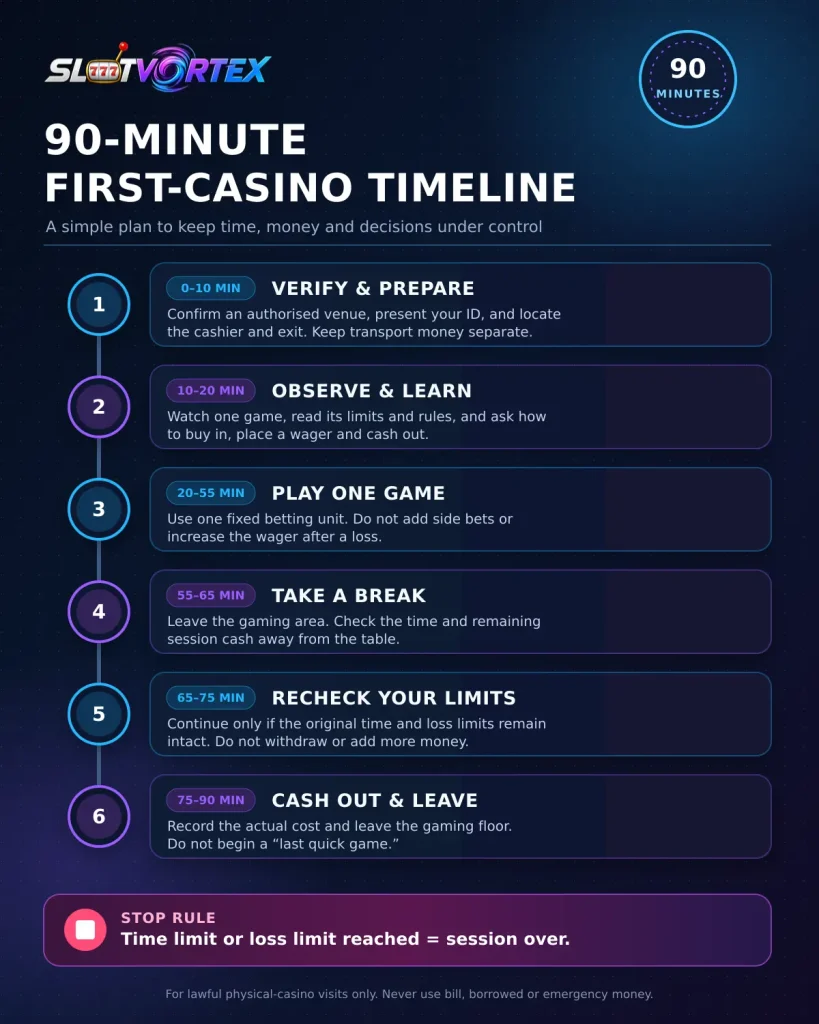
A timeline prevents the visit from turning into an open-ended session.
| Time | Action |
| Minutes 0–10 | Confirm the licence or authorised venue status, present ID, locate the cashier and note the exit. Keep transport money separate. |
| Minutes 10–20 | Observe one game. Read its limits and rules. Ask the dealer how to buy in, place a wager and cash out. |
| Minutes 20–55 | Play only the selected game with the fixed unit. Do not add side bets or increase the wager after a loss. |
| Minutes 55–65 | Leave the gaming area for a break. Check the time and remaining session cash away from the table. |
| Minutes 65–75 | Continue only if the original time and loss limits remain intact. Do not withdraw more money. |
| Minutes 75–90 | Cash out, record the actual cost and leave the gaming floor. Do not start a “last quick game.” |
Stopping ahead does not predict that the next round will lose, and stopping behind is not surrender. Both actions enforce the earlier plan.
Use Casino Etiquette to Avoid Costly Confusion
Table procedures protect the game, so a dealer may correct an action even when the mistake is innocent.
- Keep chips behind the betting line until wagering opens. Once the dealer closes betting, do not touch them.
- Use the required hand signal in blackjack. Surveillance may rely on the visible signal rather than a spoken instruction.
- Do not touch cards unless the table rules allow it.
- Buy in between rounds where possible, place cash on the table rather than handing it directly to the dealer, and wait for the dealer to count it.
- Keep a phone away from the layout. Photography and video are often restricted on gaming floors.
- Ask before joining a crowded table or occupying a seat to watch.
- Never criticise another player for a result. Their choice does not change the probability of the next independent spin or deal.
- Avoid alcohol before and during play. Impaired judgement makes a fixed budget easier to abandon, and venues can refuse entry or remove an intoxicated guest.
When unsure, ask the dealer before acting.
Reject Six Casino Myths Before They Affect a Bet
| Myth | What is actually happening | Better response |
| “Red has missed six times, so it must come next.” | Previous roulette spins do not make red due. | Treat each spin as a new random event. |
| “I can double after every loss until I recover.” | A Martingale-style system meets table limits, bankroll limits and losing streaks. It does not remove the house edge. | Keep the same small unit and never chase. |
| “This slot has not paid recently, so it is ready.” | A random machine does not owe a win because of earlier losses. | Use the displayed rules and RTP, not a hot-or-cold story. |
| “I am playing with the house’s money now.” | A win becomes the player’s money as soon as it is received. | Include current chips in the remaining budget. |
| “A side bet pays more, so it offers better value.” | A large prize often comes with a much larger house edge. | Check the probability and edge, or skip the side bet. |
| “A loyalty reward makes a losing game profitable.” | A meal, room or point may return only a small part of expected gaming cost. | Treat a comp as a discount, never a reason to extend play. |
No betting pattern changes the underlying probability of an independent random game. A system can change the size and timing of wins and losses, but not turn a negative-expectation game into an income source.
Stop Immediately When the Plan Starts Changing
Leave the gaming floor if any of these events occurs:
- You increase the bet to recover a loss.
- You consider an ATM, credit card, loan, borrowed money or sale of an asset.
- You hide the amount or time spent from someone affected by it.
- You continue after the alarm or loss limit.
- You feel angry, panicked, numb or unusually confident.
- You are no longer tracking the amount wagered.
- Alcohol or another substance affects your decisions.
- The money is needed for bills, debt or another financial goal.
Cash out without another round, leave and tell a trusted person what happened. If gambling repeatedly causes financial stress, secrecy, relationship conflict or difficulty stopping, pause completely and seek qualified support. The World Health Organization notes that gambling harm can affect finances, relationships and mental health.
First-Casino Pocket Checklist
Before placing the first wager, confirm every box:
- This venue and activity are legal where I am.
- I meet the age rule and carry accepted original ID.
- My gaming money is separate from travel, food and bills.
- I know my session amount, standard wager and end time.
- I understand the game’s full rules, payout and house edge.
- I will not use side bets, an ATM or borrowed money.
- I have set an alarm and planned my transport home.
- I am willing to stop with either a loss or a win.
The Bottom Line
The best casino tips for beginners do not promise a winning session. They reduce avoidable mistakes. Check the law, use a licensed physical venue, treat the budget as an entertainment cost, learn one transparent game, compare house edges, keep the wager fixed and leave at the planned time.
If losing the full session amount would cause regret, stress or a financial problem, the correct bet size is zero. Free, non-monetary practice or the venue’s dining and entertainment can provide the experience without putting money at risk.
Sources and Methodology
- Government of India, Promotion and Regulation of Online Gaming Act, 2025 and Promotion and Regulation of Online Gaming Rules, 2026
- UK Gambling Commission, Return to Player: How Much Gaming Machines Payout
- World Health Organization, Gambling Fact Sheet
- Current published venue terms for age, identification and floor conduct
- Standard probability calculations for blackjack, baccarat, craps, roulette and slots; exact venue rules may change the stated edge
